- Feroz Gandhi Market, Ludhiana, Punjab, India
- info@fourthX.com
- +91 740 740 7004

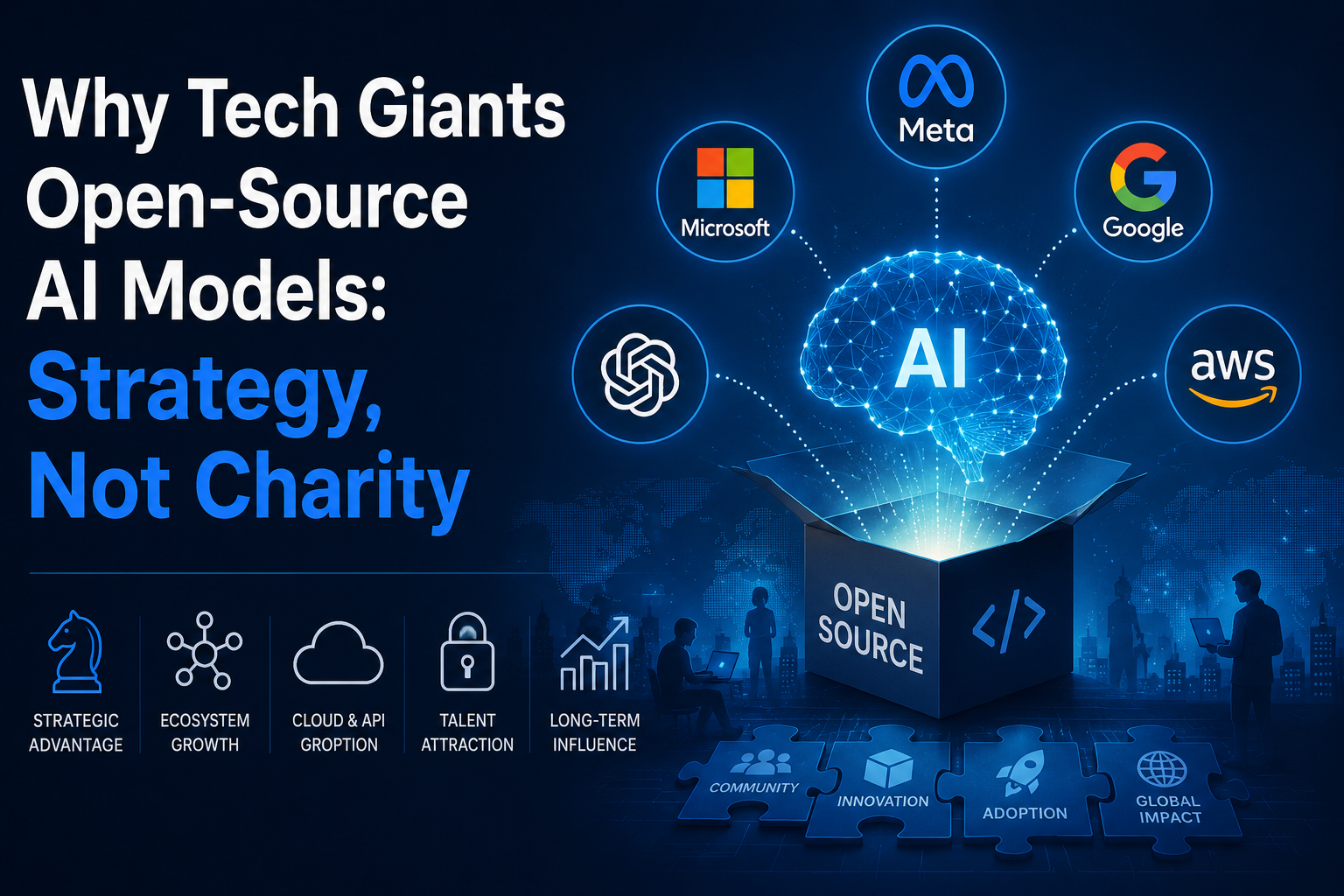
The release of open AI models like Gemma, Llama, and other “open-weight” systems has created a common question in the tech world:
“Why would billion-dollar companies give away something so powerful?”
The short answer is:
They are not giving it away out of pure generosity.
They are doing it because open models create strategic advantages.
This does not mean open-sourcing AI is fake or useless. It means the motivations are practical, economic, political, and competitive.
Below is the straight explanation most PR announcements avoid.
When a company releases a model publicly, developers worldwide start building tools, apps, fine-tunes, datasets, and infrastructure around it.
That creates an ecosystem.
And ecosystems are more valuable than a single product.
For example:
Result?
The model becomes a standard.
In technology, becoming the standard is often more valuable than selling the product itself.
This is exactly how:
Open ecosystems attract talent, startups, researchers, and eventually enterprise customers.
AI models improve through usage.
The more people use a model:
Instead of hiring 10,000 internal researchers, companies effectively get millions of external testers and contributors.
The community becomes free R&D.
This massively accelerates development.
In practical terms:
The company benefits from all of it.
This is one reason open models evolve so quickly.
This is one of the biggest reasons and rarely stated openly.
If one company fully controls powerful AI through closed APIs, they can dominate the market.
Open models prevent that monopoly.
For example:
This is strategic warfare in tech.
If everyone depends on one closed model provider, that provider controls:
Open models dilute that power.
Companies selling chips and cloud infrastructure benefit enormously from open models.
Why?
Because open models increase compute demand.
When developers run models locally or on cloud servers:
That benefits companies like:
Even if the model itself is free, the infrastructure economy around it is massive.
Sometimes the real business is not the model.
The real business is:
The “free” model drives paid infrastructure usage.
AI companies face growing criticism about:
Open-sourcing models helps companies appear:
It creates goodwill among:
This matters politically and commercially.
A company viewed as “open” often gains more trust than one viewed as secretive.
This is important.
Most companies are not fully open-sourcing their crown jewels.
There is a major difference between:
Many AI releases:
So while the models are accessible, the complete competitive advantage often remains internal.
The truly valuable assets are usually:
The released model is often only part of the real moat.
This is the broader strategic play.
If AI becomes deeply integrated into:
then the companies shaping that ecosystem today gain enormous long-term influence.
Open models accelerate adoption faster than closed systems alone.
More adoption means:
The companies understand this very clearly.
Tech giants are not charities.
But they are also not stupid.
Open-sourcing AI models is a calculated business strategy that simultaneously:
The interesting part is this:
Their self-interest still benefits the broader world.
Because even strategic openness can democratize technology.
Today, students, startups, researchers, and independent developers can access capabilities that would have been impossible a few years ago.
That changes the balance of innovation globally.
And that is the real game behind open AI models.