- Feroz Gandhi Market, Ludhiana, Punjab, India
- info@fourthX.com
- +91 740 740 7004

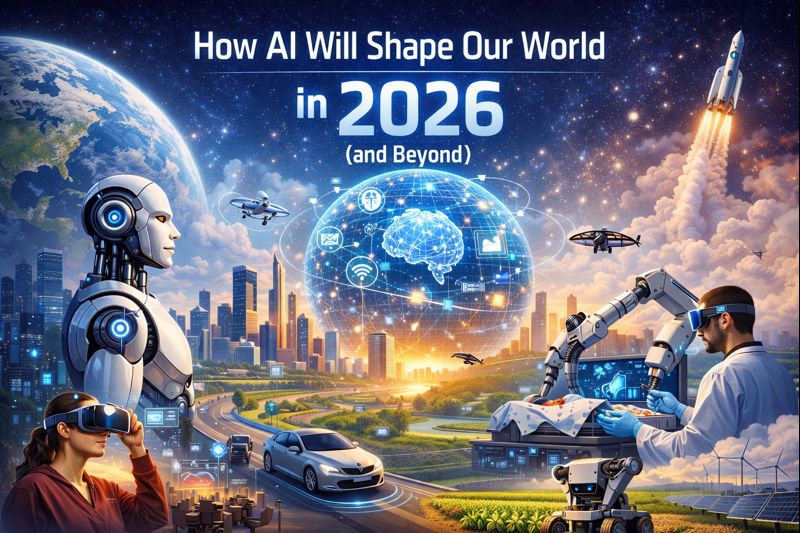
Why the next year will define the future of technology, business, and human-AI collaboration.
As we move from 2025 into 2026, artificial intelligence (AI) is no longer just a buzzword or a “nice to have” it’s shaping how industries operate, how decisions are made, and how people work and live. What started as early experiments with machine learning and generative tools has matured into systems that are deeply embedded into business logic, productivity workflows, and everyday digital experiences.
So what does the near future hold as we enter 2026? Let’s explore.
In 2025, AI adoption accelerated. Global enterprises moved beyond experimentation and began integrating AI into core operations from cloud infrastructure and automation to customer service and analytics. Large language models (LLMs), like ChatGPT and others, became ubiquitous tools for content creation, support systems, and knowledge work. Generative AI began surpassing simple text and image tasks to assist in complex workflows across industries.
Governments, researchers, and industry leaders also focused on responsible adoption. The first independent international AI safety report and major global summits worked toward common frameworks.
However, AI’s rapid rise also brought challenges from rising cybersecurity threats powered by AI to infrastructure bottlenecks and debates about governance and ethics.
By 2026, we are poised to shift from “What can AI do?” to “How well and how safely can it do it?”
Here are the key trends shaping 2026:
Rather than isolated tools, AI systems will act more like digital coworkers – autonomous agents that can plan, execute, and complete tasks with minimal human oversight. These agents will coordinate across environments – from inboxes to development workflows – making teams more productive and creative.
Next-generation AI will operate not just in the cloud but also on devices. Edge AI will deliver real-time insights in healthcare, manufacturing, logistics, and more – reducing latency, increasing privacy, and reducing dependency on centralized data centers.
While diagnostics and care planning are already benefiting from AI, 2026 will likely see biomedical models that rival the scale of today’s largest language models – enabling better handling of rare conditions and more accurate guidance based on vast, diverse datasets.
AI workloads will drive cloud growth not just for experimentation but as infrastructure staples. Enterprises are optimizing performance and cost with next-generation processing units and specialized cloud ecosystems, reshaping how business systems run.
As AI grows more autonomous and capable, ethical design, explainability, and safety will become mainstream considerations – not afterthoughts. Standards, audits, and transparency frameworks will help ensure AI builds trust, not fear.
AI will not simply replace jobs – it will reshape them. By handling repetitive or analytical work, AI can empower humans to focus on creativity, strategy, and emotional intelligence. The narrative is shifting from “AI vs humans” to “AI + humans” working together.
For startups and enterprises alike, AI is no longer optional – it’s strategic:
• Operations become smarter: AI can identify patterns, optimize supply chains, and automate workflows in real time.
• Products become more intuitive: From personalized user experiences to intelligent automation, AI enhances customer value.
• Insights turn into action: AI transforms data from static dashboards into proactive decision engines.
• Competitive advantage grows: Organizations that integrate AI meaningfully will redefine what it means to lead in their industry.
With opportunity comes responsibility. As AI becomes more integral:
Business leaders must not only embrace AI – they must govern it wisely.
Entering 2026, we are redefining the frontier of innovation. AI isn’t just enabling faster work or smarter systems – it’s reshaping the very nature of how humans and machines collaborate.
At fourthX Technologies, we see this era not as a challenge, but as an invitation: to build smarter tech, to prioritize responsible AI, and to empower our clients with solutions that are scalable, secure, and transformative.
The future won’t be defined by those who merely adopt AI – but by those who integrate it strategically and responsibly into the heart of their business.
#AI2026 #ArtificialIntelligence #DigitalTransformation #Innovation #fourthXTechnologies #FutureOfWork #TechTrends #EnterpriseAI #AIIntegration #ResponsibleAI #AIinBusiness #IntelligentSystems